
Influencers, Misinformation and Meningitis in the UK
The Kent Meningitis Outbreak and the Misinformation Playbook: Conspiracy Theories, Institutional Mistrust and Influencers.
During the COVID-19 pandemic, health misinformation surged on social media with devastating real-life consequences, fuelling public mistrust in health institutions and undermining effective public health responses. But as lockdowns were lifted and social distancing became a distant memory - did the health misinformation narratives born out of the COVID-19 pandemic fade away too?
Fast forward seven years since COVID-19 broke out, and public health crises continue to erupt: a recent example is the meningitis outbreak in Kent that began in March 2026. Signify measured the engagement around posts about the meningitis outbreak on Instagram and analysed the narratives surrounding them. Our goal was to identify and analyse users’ reactions to the outbreak while measuring engagement with misinformation content.
Within days of the outbreak making headlines, users on social media were already drawing parallels to COVID-19, espousing conspiracy theories, and urging parents not to vaccinate their children against a disease that can kill within hours. In an era where trust in institutions and health authorities is eroding, misinformation which is positioned as the ‘’hidden truth’’ drives trust and deepens engagement. There is a reason why internet researchers call online discourse an ‘’attention economy’’: a number of high-profile accounts spreading false beliefs were directly monetising from their profiles, linking to alternative health-related products, books and courses.
As social media becomes ever more central to how we communicate and share information, misinformation can quickly embed in our worldviews and belief systems. Health misinformation is a public health risk - and mapping the narratives surrounding it means being in a position to effectively respond to it.
Methodology
Signify conducted research on the level of health misinformation on Instagram following the meningitis outbreak in the UK. Using the hashtags #meningitis and #meningitisoutbreak, Signify collected 1,524 posts over the month following the meningitis outbreak and developed a bespoke Large Language Model (LLM) classifier to determine whether a post constitutes misinformation. Following this AI-powered triage, human reviewers confirmed whether the classification was accurate and clustered the misinformation posts into categories.
In terms of volume, only 4.5% of posts were classified as misinformation. However, when measuring engagement, posts that were classified as misinformation amassed 178,320 likes - accounting for 17.1% of total likes with posts about meningitis on Instagram. Meanwhile, 27.3% of the overall comments under meningitis posts were under those flagged as misinformation, signaling that spreading false narratives generates engagement. Given that our methodology included hashtags exclusively, we anticipate misinformation rates to be significantly higher, especially from bad actors evading moderation by avoiding obvious hashtags or using algospeak.
Engagement with Meningitis posts
Human analysts reviewed all posts classified as misinformation, verifying the LLM and clustering each post into categories. The categories were decided upon by our team of analysts after having reviewed content - and are not LLM driven.
Misinformation Narratives
Conspiracy Theories
Signify's analysts' classification reveals that the most engaged-with category under meningitis misinformation posts was conspiracy theories. Several users alleged that the outbreak is a "distraction tool" and a fabricated attempt to control the masses through vaccinations. Comparing the meningitis outbreak to COVID-19, users suggested that the Kent epidemic followed "the same playbook" as the pandemic. The most liked post (33k likes) argued that the meningitis outbreak in Kent is part of a population control attempt, where "they will be left with the chipped sheep only" - referencing unspecified elites and using derogatory language to describe vaccinated people. Other posts linked the outbreak to Bill Gates - who allegedly warned of a second pandemic - suggesting that the meningitis outbreak is a distraction tool that "the corrupt media" uses to cause fear, linking the outbreak to the Epstein files and the war in Iran and Israel.
In line with conspiracy theory language, users claimed that deliberately vague, puppet-master elites control our attention, and that epidemic outbreaks are one of their many strings to pull. The abstractness follows through: unidentified "theys", unjustified reasons why the masses are being controlled, and uncertainty over what the masses are being distracted from. The extent of their conspiratorial denialism and the parallels drawn with the COVID-19 pandemic or general distraction agendas are nebulous; COVID-19 is not always mentioned explicitly but is rather implied - and the extent to which it was real in itself or purposely caused is left unsaid.
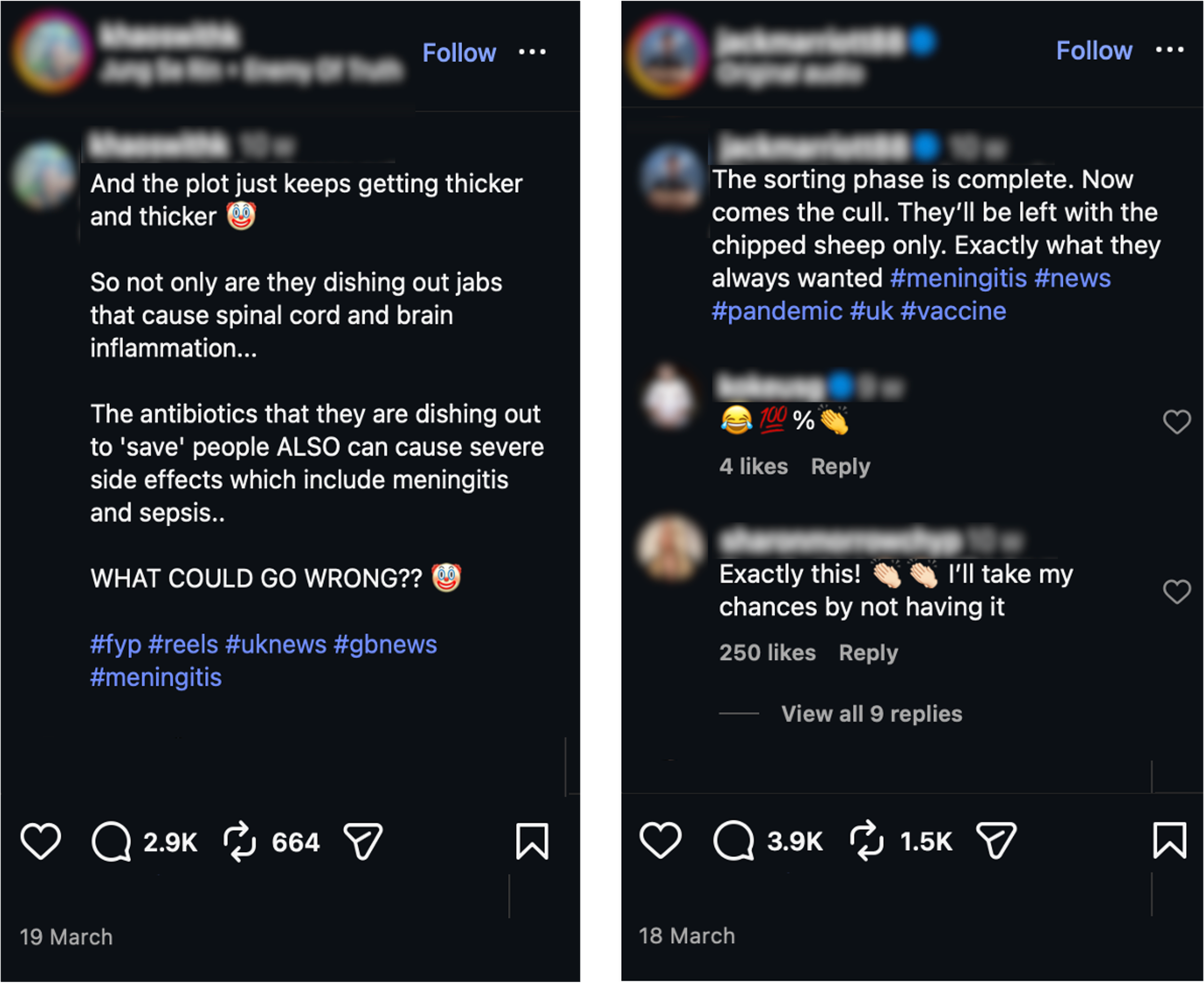
Example posts describing conspiracy theories
COVID-19 Pandemic & Exercise Pegasus
Pandemic fatigue prompted several users to question whether the meningitis outbreak would lead to another lockdown in the UK. Niche misinformation narratives frequently linked the meningitis outbreak to Exercise Pegasus, the UK government's pandemic preparedness exercise from September to November 2025. Users treated the simulation as proof of orchestration of the meningitis outbreak, citing official government URLs. On that basis, users also paralleled the meningitis outbreak in Kent with Event 201, a fictional pandemic simulation exercise that took place in 2019 - and has also been cited by people claiming that COVID-19 was planned. Unlike wider conspiratorial narratives abstractly linking health epidemics to "the elites" and efforts to control populations, explicit conspiratorial links to COVID-19 blame the government directly and draw credibility from government sources (e.g. official URLs). This signals a degree of direct institutional mistrust towards the government, with real documents being weaponised as evidence.
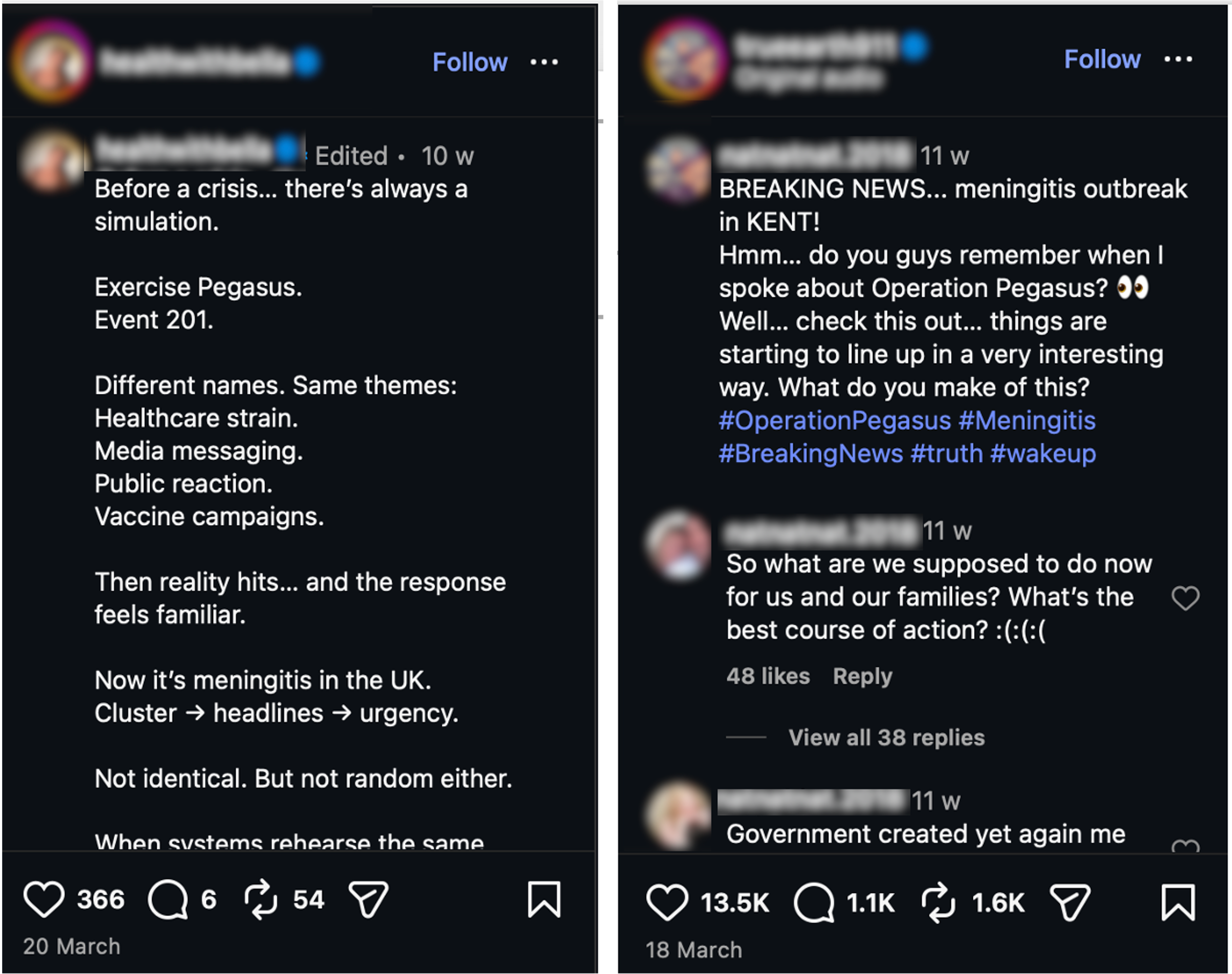
Example posts that cite Operation Pegasus as a conspiracy
Anti-vaccine & Health Misinformation
Anti-vaccine narratives spanned mere hesitancy to mistrust in science and health institutions, framing vaccines as a form of bodily coercion, and advocating natural remedies. Most concerningly, anti-vaccination posts included explicit calls not to vaccinate children, bolstering parental moral panic around meningitis vaccinations and putting minors at serious health risk. Narratives around bodily autonomy and accusations of coercion to take the vaccine were prolific, with users explicitly or implicitly advocating "doing one's own research" - demonstrating mistrust of health professionals and institutions. Distrust of health authorities was paired with conspiracy theories alleging that mass vaccinations are part of a population control agenda, where refusal meant resistance. Users claimed health emergencies only arise when relevant vaccinations are available, and raised questions over the lack of focus on "preventative" methods such as homeopathy, removing toxins from foods or eliminating contaminated crops from medical waste.
Health misinformation posts revealed varying degrees of vaccine hesitancy based on erroneous facts, such as that the only way to catch a virus is through an injection. This may read as an absurd statement, but it does not reduce its danger when spread to susceptible audiences. Most critically, several posts promoted alternative treatments, including homeopathy, or directed people away from antibiotics when meningitis without immediate treatment can be fatal.
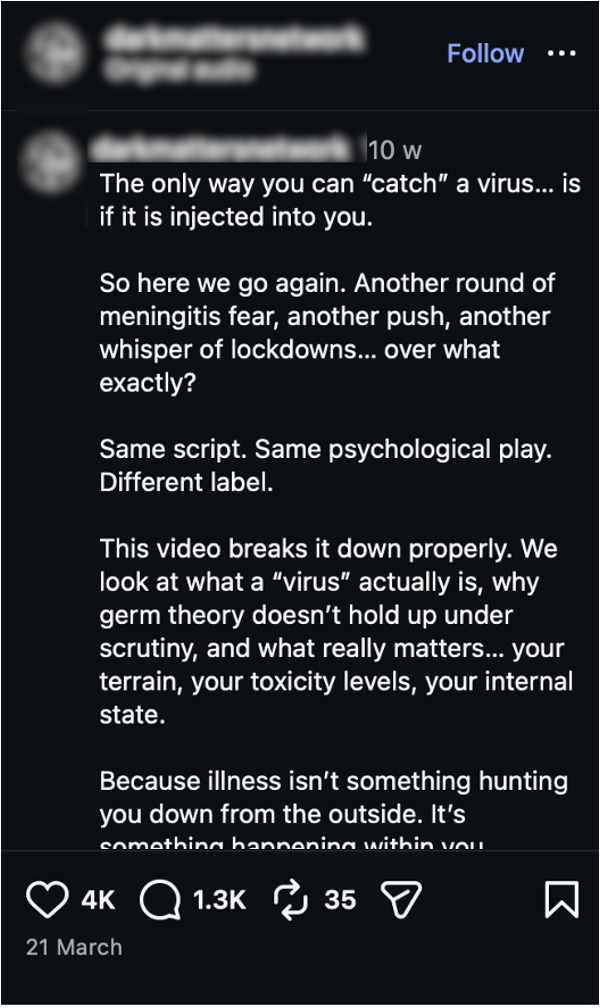
Example of an anti-vax post
A deep-dive into the accounts
This research begs the question: who is behind these posts? Signify's work has consistently shown that misinformation is rarely incidental. While the accounts we identified do not reveal any coordinated misinformation networks (e.g. links between the accounts spreading shared information or near-identical narratives) a striking number of the most-followed accounts posting misinformation had clear monetisation incentives.
Signify identified 29 accounts spreading misinformation in this study, with a combined following of just under 1.5 million. Of the top 15 most-followed accounts, over half are explicitly monetising their pages. Monetisation schemes fall broadly into three categories:
Alternative health products, services and courses (consultation services, herbal health guides, children’s health books, and homeopathy courses);
Paid content and engagements (Patreon, membership subscriptions, and online events);
Direct financial support models (PayPal and Buy Me a Coffee).
These monetisation schemes are not directly linked to meningitis however, creators drive engagement to their pages by spreading health misinformation - which then increases their chances to monetise from their accounts. Misinformation is not incidental to their pages - it contributes to building the audience.
Conclusion
Misinformation - here and elsewhere - is a powerful engagement tool. Even before social media, tapping into hidden truths, secret knowledge, and alternative theories has always sparked attention. When information is presented as hidden, the messenger exposing or sharing that information is more likely to be trusted - and conspiratorial or controversial framing drives up engagement. The sheer number of misinformation comments validates this; users engage with misinformation content deepening its effects quite literally - with their comments - but also algorithmically, by pushing misinformation content further into people’s feeds. This is the pinnacle of spreading misinformation in an attention economy - where commanding that attention drives profit.
Our findings demonstrate that misinformation, when left unaddressed, creates narratives that take hold. People's mistrust towards vaccines and health authorities, and the links being drawn with the COVID-19 pandemic, demonstrate strongly held convictions. Misleading narratives are rarely stand-alone; they have created a whole ecosystem of vaccine denial, media and elite control, and bodily autonomy rhetoric - showcasing how unchecked misinformation can evolve not only into narratives, but into entrenched worldviews.
Health crises have always existed but the scale and speed of misinformation spread on social media can severely undermine effective response mechanisms to mitigate such risks. How could public authorities effectively address health crises if people online are told not to trust them? Mapping the narrative landscape to counter health misinformation is fundamental to building trust in health institutions and effectively responding to health crises. This is not academic exercise - it is the first line of defence.
—
About us:
Signify is an ethical data science company founded in 2017. We monitor online abuse and track the spread of political narratives across social media platforms and news. This piece was written by Research Manager Ifigenia Moumtzi with data gathering by the Insights team.
If you’re interested in tracking how misinformation narratives spread, mapping information ecosystems and understanding the role of influencers in narrative amplification - get in touch.